
















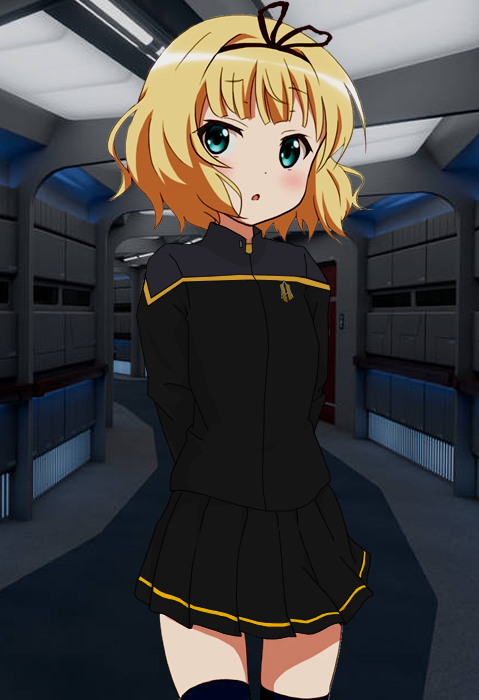



Vice Admiral Alina Clover
Name Alina Clover
Position Chancellor of Starfleet Academy
Rank
 Vice Admiral
Character Information
| Gender | Female | |
| Species | Human/El-Aurian | |
| Age | 212 |
Physical Appearance
| Height | 5'7" | |
| Weight | 128 lb | |
| Hair Color | Mauve-brown | |
| Eye Color | Green | |
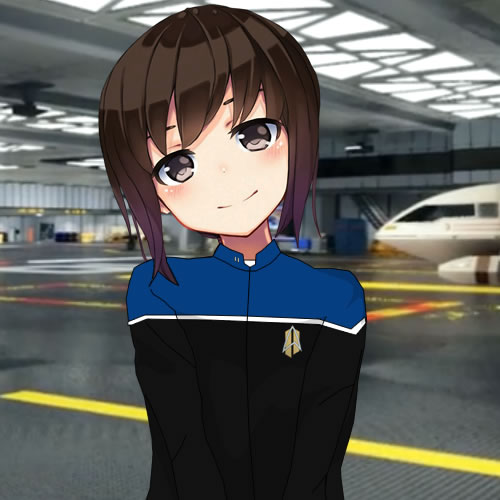
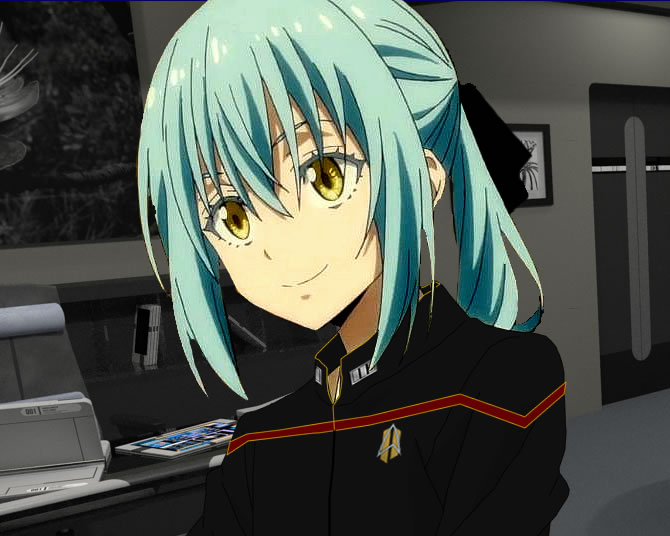
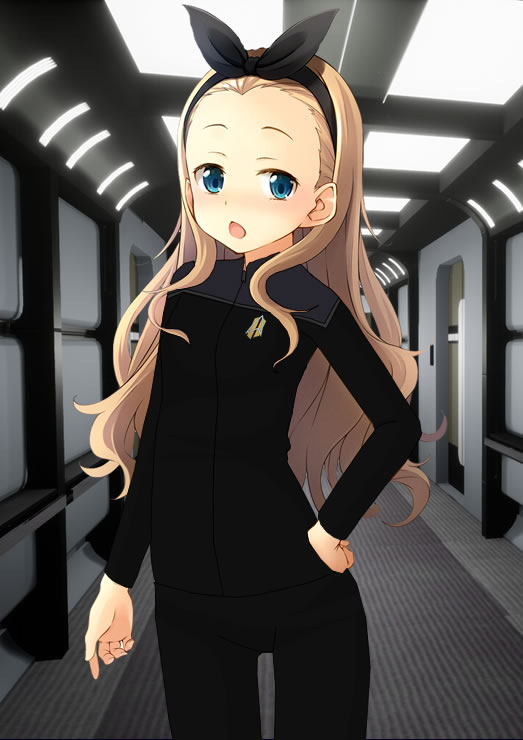
| Physical Description | Alina has a slender, athletic build, a fair complexion and long mauve-brown hair. She usually wears her hair partially gathered into a braid over one shoulder, keeping it clear of her face without entirely concealing its length. Her green eyes are expressive, particularly when her carefully maintained professional composure begins to slip. Her inherited longevity has greatly slowed her physical ageing. Despite being more than two centuries old, she appears to be in her early thirties. This reflects her individual hybrid physiology. Alina maintains her fitness through regular exercise and continued practical training. Her movements are assured and economical, and she carries herself with the confidence of someone accustomed to command. Her youthful appearance and approachable expression sometimes lead unfamiliar visitors to underestimate her experience. She is slightly taller than her personal assistant, Laila Bennett. She takes care with her uniform and presents herself appropriately for her responsibilities. Off duty, she favours comfortable, practical clothing and dislikes feeling obliged to dress ceremonially simply because someone recognises her rank. Her displeasure is rarely difficult to detect once someone knows her. A fixed smile, a slight tightening of her jaw and an exceptionally measured tone generally indicate that her patience is approaching its limit. |
Family
| Relationship Status | Widowed | |
| Spouse/Partner | Dr Nathaniel “Nathan” Clover: Human. Born in 2251; died in 2348. A civilian astrophysicist. Married Alina in 2281. | |
| Children | Daughter: Dr Evelyn Clover: Born in 2286. A civilian planetary scientist specialising in planetary environments and long-term habitability. Married to Daniel Hart, a Human civilian infrastructure specialist. Son: Adrian Clover : Born in 2294. A retired Starfleet engineer who continues to undertake civilian engineering work. Married to Tessa Renn, a Human civilian physician. |
|
| Father | Thomas Vale: Human. Born in 2149; died in 2241. A civilian mathematician and educator based in Cambridge. | |
| Mother | Seris Vale: El-Aurian. Born in 2021. An astrometric researcher who settled on Earth in 2172. She remains alive in 2397 and resides on Earth. | |
| Other Family | Miriam Hart: Evelyn and Daniel’s daughter. Born in 2341. A civilian ecological researcher. Julian Clover: Adrian and Tessa’s son. Born in 2356. A civilian transport systems engineer. Sophie Clover: Adrian and Tessa’s daughter. Born in 2365. A civilian musician and music teacher. |
Personality & Traits
| General Overview | Alina is practical, capable and independent, with a strong preference for resolving problems before they consume everyone’s time. She enjoys meaningful work and takes considerable pride in doing it well. Her frustration is reserved for unnecessary repetition, neglected responsibilities and procedures that have continued long after their purpose has disappeared. In public, she is pleasant, articulate and attentive. She understands the value of making people feel welcome and can put an anxious cadet or visiting civilian at ease without appearing to patronise them. When dealing with difficult visitors, she listens, establishes the facts and explains the situation clearly. In private, she is considerably more blunt. Trusted colleagues hear the exasperated remarks that would never appear in an official briefing. She has a dry sense of humour, a stubborn streak and a talent for expressing an uncomfortable truth in a very short sentence. Her scientific training remains central to how she thinks. She asks what evidence supports a conclusion, which assumptions have gone untested and what would happen if those assumptions proved wrong. She has little patience for confident assertions that collapse under the first reasonable question. Although she has lived for more than two centuries, Alina remains emotionally engaged with the present. She enjoys good food, familiar company, an interesting investigation and an evening that belongs entirely to her. She can become excited by a discovery, irritated by a nuisance or embarrassed by affectionate teasing. Alina values her time because she understands how readily service can consume it. She objects strongly to the idea that exhausted personnel are necessarily dedicated personnel. She will remain at work for a genuine emergency, but expects avoidable overtime to be treated as a problem requiring correction. She extends this principle to others. Cadets and staff should work hard, meet reasonable standards and receive adequate time to rest. A senior officer who repeatedly compensates for poor planning by keeping subordinates late is likely to receive more criticism than someone who admits early that a deadline cannot be met. Her El-Aurian heritage is reflected in her patience when listening to matters of genuine importance and in the long perspective she brings to relationships. Her perceptiveness also rests on experience and attention. She recognises that even a familiar situation may contain circumstances she has not yet understood. |
|
| Strengths & Weaknesses | Strengths - Extensive experience in scientific operations, exploration and starship command. - Strong analytical judgement and willingness to question unsupported assumptions. - Composure during emergencies and confidence in making difficult decisions. - Clear communication and an ability to identify the central issue in a complicated discussion. - Practical empathy, particularly concerning personnel welfare. - A strong memory for people, decisions and the consequences of earlier mistakes. - Independence and the confidence to challenge senior colleagues when necessary. - Continued physical readiness and maintained command qualifications. - Loyalty to her personnel and willingness to accept responsibility for her own decisions. Weaknesses - Impatient with inefficiency and occasionally dismissive before hearing the full explanation. - Inclined to intervene personally when delegation produces slower results than she wants. - Can intimidate inexperienced officers without recognising how strongly they react to her reputation. - Finds it difficult to tolerate the same mistake after she believes it has been clearly addressed. - Sometimes compares present situations too readily with incidents from her long career. - Resists appearing vulnerable and can deflect concern with humour or irritation. - Becomes overprotective when someone she cares about is struggling. - Has difficulty accepting that family members may want sympathy rather than a solution. - Remains sensitive to losing loved ones, despite her outward confidence. |
|
| Ambitions | Alina wants the Academy to produce officers who can think clearly, behave ethically and care for the people placed under their authority. She places particular value on practical judgement: knowing when to follow an established procedure, when to seek advice and when circumstances demand another approach. She hopes to keep scientific curiosity at the centre of Starfleet education. Her wartime experience has reinforced her belief that officers must be capable of defending the Federation while retaining their commitment to exploration, discovery and cooperation. Professionally, she has little interest in promotion for its own sake. She prefers an appointment where her judgement produces useful results. She remains at the Academy because she believes she can still improve the preparation and welfare of future officers. Personally, she wants to remain involved in her family’s lives, protect time for her own interests and allow herself companionship without treating it as a betrayal of her marriage. |
|
| Hobbies & Interests | Alina retains an active interest in astrophysics and stellar cartography. She enjoys reading current research and occasionally attends scientific presentations without announcing her presence in advance. Her questions can be challenging, but she appreciates a researcher who acknowledges uncertainty honestly. She enjoys swimming, strength training and controlled sparring. These activities provide exercise and a welcome break from administrative work. She takes safety seriously and respects the expertise of her instructors. She likes walking through San Francisco, trying small restaurants and finding somewhere quiet to read. Good meals and peaceful evenings are pleasures she protects with determination. Her family introduced her to several generations of music, games and entertainment. She retains favourites from different periods but enjoys discovering something new, particularly when a grandchild insists she must hear or watch it. Alina also enjoys cooking when she has sufficient time to do it properly. She can become unnecessarily competitive about a recipe and is not above blaming an unfamiliar kitchen for a disappointing result. |
| Personal History | Early Life: 2184–2202> Alina was born in Cambridge to Thomas and Seris Vale. Her father taught mathematics, while her mother worked in astrometric research. Their household encouraged questions, discussion and independent investigation. Alina learned early that disagreeing with an explanation was acceptable if she could explain why. Thomas contributed warmth, humour and a grounded appreciation of everyday life. Seris brought a much longer perspective and a patient approach to listening. Their contrasting temperaments gave Alina both an appetite for immediate practical answers and an awareness that some questions required time. As a child, Alina was curious, stubborn and quick to notice inconsistencies. She enjoyed solving problems but was less enthusiastic about repeating work she believed she had already mastered. Her parents encouraged her ability while requiring her to consider how her impatience affected others. Her mixed heritage became more apparent as she grew older. Medical monitoring indicated that her adult ageing would differ considerably from that of most Human peers. The prospect initially seemed abstract. Its emotional consequences became clearer only as friends and relatives aged around her. She chose Starfleet because it offered an opportunity to investigate the universe directly. Science was her first ambition; command emerged much later. Academy and Early Scientific Service: 2202–2248 Alina entered Starfleet Academy in 2202. She concentrated on astrophysics, stellar cartography and planetary science, developing a particular interest in extracting reliable information from incomplete sensor observations. Her academic performance was strong, although teamwork required adjustment. She initially assumed that identifying the best solution entitled her to direct everyone towards it. Instructors taught her to explain her reasoning, listen to alternatives and recognise when another person’s expertise exceeded her own. Commissioned in 2206, she joined the USS Kestrel as a junior science officer. Shipboard service exposed her to the difference between a classroom problem and an investigation conducted with limited equipment, uncertain information and competing operational demands. She enjoyed the work immensely. Long watches, failed experiments and routine maintenance were tolerable when they served a clear purpose. She was less forgiving of incomplete handovers or reports copied forward without checking whether their conclusions remained valid. Her promotion to Lieutenant Junior Grade brought responsibility for survey teams and individual projects. She learned to supervise personnel with different skills and temperaments, and discovered that a technically correct instruction could still be badly communicated. On transferring to the USS Resolute in 2218, she became Assistant Chief Science Officer. Her responsibilities expanded to laboratory coordination, research planning and the preparation of recommendations for command. Promoted to Lieutenant Commander in 2230, she took charge of the science department. She completed bridge officer qualifications and became increasingly involved in wider ship operations. Commanding a watch appealed to her because it allowed her to resolve problems across departmental boundaries. Her father’s death in 2241 was an important personal turning point. She returned home to support her mother and attend the funeral. At fifty-six, turning fifty-seven that year, she still appeared young while her father had lived into his nineties. The contrast made her longevity feel concrete in a way medical explanations never had. Transition into Command: 2248–2270 In 2248, Alina transferred to the Constitution-class USS Meridian as Chief Science Officer and Second Officer. The assignment provided broader exploration opportunities and a more demanding command environment. Her captain encouraged her to think beyond scientific objectives. A promising investigation might carry diplomatic risks, exhaust available resources or require the crew to accept hazards disproportionate to its likely value. Learning to balance these concerns helped her become a more rounded officer. In 2262, she became Executive Officer. Leaving daily leadership of the science department was difficult, and she initially interfered too readily with her successor’s work. Her captain required her to allow the new department head room to make decisions. The lesson remained important throughout her career. Competence in a former role did not mean she should continue doing it after accepting another. As Executive Officer, she developed a firm approach to personnel management. She expected preparation and accountability, but became increasingly aware that avoidable fatigue and unclear instructions could create failures wrongly attributed to individual weakness. By 2270, she was ready for a command of her own. First Command, Marriage and Parenthood: 2270–2318 Alina’s first command was the Constitution-class USS Halcyon. She remained with the ship through its refit in 2273 and led successive exploration, survey, diplomatic and humanitarian assignments. Command suited her, although it also exposed the limits of her preference for personal intervention. She could no longer investigate every anomaly herself or resolve every departmental disagreement. Building a dependable senior staff became one of her greatest professional achievements. She met Nathaniel Clover in 2278 during a joint scientific project. Nathan was a civilian astrophysicist whose interest in difficult observations matched her own. Their early disagreements were lively, precise and thoroughly enjoyable to both of them. Nathan was neither overawed by her rank nor careless about her responsibilities. He respected her work while expecting her to communicate clearly and honour the time they set aside for one another. Alina valued the ease with which he treated her as a person rather than a commanding officer. They married in 2281. Alina adopted Clover as her surname and retained it throughout the rest of her career. Their daughter, Evelyn, was born in 2286. Adrian followed in 2294, after Alina’s transfer to the Excelsior-class USS Valorous. Parenthood required deliberate adjustments to her service, including family leave, arranged shore periods and suitable accommodations when Nathan and the children accompanied her. On deployments unsuitable for dependants, the family maintained a home on Earth. Alina remained continuously commissioned, but family arrangements required discussion and compromise. Nathan undertook much of the children’s daily care during her deployments, and both parents worked to preserve her involvement. She was an affectionate mother with a tendency to organise solutions before establishing whether anyone wanted them. Evelyn and Adrian learned to distinguish between asking for advice and merely telling her about their day. Her marriage endured through distance, disagreements and changes in assignment. Nathan could challenge her stubbornness without turning every disagreement into a contest. Their relationship gave her a private space where she could be tired, uncertain or ridiculous without feeling she had undermined her authority. Established Captain and Bereavement: 2318–2365 In 2318, Alina took command of the Excelsior-class USS Dauntless. By then, she had decades of command experience and a well-developed understanding of the responsibilities she wanted to retain. She remained a Captain because she enjoyed starship command. A more senior position was attractive only if the work itself interested her. Her longevity allowed her to spend substantial periods developing crews, undertaking exploration and mentoring officers without treating every assignment as a brief step towards promotion. Evelyn pursued planetary science, while Adrian entered Starfleet engineering. Alina was proud of both choices, although Adrian sometimes found comparisons with his mother’s career exhausting. She made an effort to avoid involving herself in his assignments or evaluations. In 2344, she transferred to the Ambassador-class USS Endeavour. Its scientific capabilities suited her interests, and she welcomed the opportunity to command a newer generation of explorer. Nathan died in 2348 at ninety-seven. They had been married for sixty-seven years. His ageing had been gradual and familiar, but knowing that their lifespans differed did not make his death easy to accept. Alina took bereavement leave and spent time with her children and mother. Returning to command provided structure, but she recognised that work could become a way of avoiding grief if she allowed it. She kept the name Clover because it belonged to her life as well as her marriage. In later years, she could speak of Nathan with humour and affection. She continued to miss him, particularly in the ordinary moments they had once shared. Nebula-Class Command: 2365–2370 In 2365, Alina transferred to the Nebula-class USS Polaris, retaining the rank of Captain. The ship became one of her favourite commands. Its scientific facilities and operational flexibility allowed her to pursue research, surveys and reconnaissance while maintaining a capable exploration command. She appreciated a ship that could support detailed investigation without sacrificing its ability to respond to an emergency. Although she had long since left the science department, her interest remained active. Her Chief Science Officer could expect informed questions, enthusiastic discussion and occasional reminders from the Executive Officer that the captain had other appointments to attend. She worked to give her specialists room to lead their own investigations. Her tendency to become personally absorbed in a promising discovery occasionally tested that discipline. After five years, she left Polaris with genuine affection for the ship and its crew. Galaxy-Class Command and the Dominion War: 2370–2376 Alina was promoted to Commodore in 2370 when she assumed command of the Galaxy-class USS Concordia. Alongside command of her own ship, she received responsibility for an operational group. Concordia brought greater capacity and broader responsibilities. Alina remained its commanding officer, supported by an executive officer and a small group staff that helped coordinate the other vessels assigned to her authority. Her initial assignments combined exploration, scientific cooperation, diplomatic support and regional emergency response. The Dominion War subsequently transformed the group’s work. Exploration gave way to reconnaissance, convoy protection, evacuation, fleet support and combat assignments. Alina remained aboard Concordia and in operational command throughout the conflict. Her scientific experience proved useful in interpreting sensor information, understanding unfamiliar conditions and distinguishing reliable intelligence from optimistic assumptions. However, she could not investigate every uncertainty before making a decision. Wartime losses weighed heavily on her. Experience helped her act, but did not make the deaths of personnel easier to regard as statistics. She expected accurate casualty reporting and made time for notifications and the welfare of survivors. Following the war’s end in 2375, she retained command during relief and recovery operations. The work reinforced her concern that officers needed preparation for both conflict and the responsibilities that followed it. Academy Leadership: 2376–2397 In 2376, Alina accepted appointment as Chancellor of Starfleet Academy and promotion to Rear Admiral. It was her first permanent move away from shipboard service since commissioning. She initially struggled with the volume of committees, competing priorities and procedural discussions. Some administrative requirements were necessary; others survived because nobody had examined them recently. She expected staff to explain which was which. Her reforms focused on practical leadership, scientific judgement, communication and personnel welfare. She wanted cadets to understand that authority required accountability and that a confident voice did not compensate for a weak argument. She also worked to restore a broad sense of Starfleet’s purpose after the war. Cadets needed to prepare for dangerous assignments while retaining curiosity, empathy and the ability to cooperate across cultures. Alina was promoted to Vice Admiral in 2388 and remained Chancellor. By 2397, she had spent twenty-one years leading the Academy and approximately 191 years as a commissioned officer. Relationship with Taiga Aisaka During Taiga Aisaka’s Academy years, Alina came to know her as a young, determined cadet with considerable potential and a tendency to react defensively to criticism. Their relationship developed through occasional command reviews and significant incidents rather than daily teaching. Alina recognised Taiga’s ability while insisting that sound decisions also required communication, restraint and responsibility for the people carrying them out. Their encounters were not always comfortable. Taiga disliked feeling controlled or underestimated, while Alina was unwilling to excuse poor conduct simply because its underlying intentions were understandable. Nevertheless, Taiga gradually came to trust her fairness. By 2397, Alina regards Captain Aisaka as an experienced commanding officer whose operational judgement deserves serious attention. She remembers the cadet’s determination but recognises the maturity required to carry responsibility for a ship and crew. Taiga’s return to deliver seminars on observed Herald tactics provides an opportunity to reconnect and bring current field experience into Academy instruction. Alina intends to attend key sessions, including discussions involving serving ship commanders, and consider how those lessons should inform training. Her pride in Taiga’s development is tempered by an understanding of the losses and difficult decisions through which that experience was acquired. Relationship with Laila Bennett Commander Laila Bennett serves as Alina’s personal assistant. Alina trusts Laila’s discretion, preparation and willingness to raise concerns privately. Their working relationship combines clear professional expectations with considerable warmth. Alina appreciates Laila’s ability to make visitors feel welcome while protecting the office from unnecessary disruption. She values her judgement and expects her to speak honestly rather than simply agree. She also recognises Laila’s tendency to overwork in pursuit of being indispensable. Alina regularly reminds her that running an efficient office includes allowing its personnel to go home. Laila, in turn, helps Alina recognise when she is about to solve a problem that properly belongs to somebody else. Their mutual trust allows her to deliver such reminders without fear of being mistaken for insubordinate. Beyond their duties, they have developed a friendship that allows room for humour, ordinary conversation and occasional time together away from the Academy. Family Life in 2397 Outside the Academy, Alina remains closely involved with her family. Her mother provides perspective and is one of the few people who can still make her feel like an impatient daughter. Evelyn, Adrian and her grandchildren are affectionate but unawed by her rank. Her children have their own careers, responsibilities and opinions. Alina is learning to respect that being available to help does not mean every difficulty requires her intervention. She has not remarried. Although open to companionship, she is cautious about allowing another person into the private life she shared with Nathan. She is gradually learning that affection in the present need not diminish what came before. |
|
| Service Record | 2202–2206 Cadet Starfleet Academy Science programme 2206–2211 Ensign USS Kestrel — Walker class Junior Science Officer 2211–2218 Lieutenant Junior Grade USS Kestrel — Walker class Science Officer 2218–2230 Lieutenant USS Resolute — Walker class Assistant Chief Science Officer 2230–2248 Lieutenant Commander USS Resolute — Walker class Chief Science Officer 2248–2262 Commander USS Meridian — Constitution class Chief Science Officer / Second Officer 2262–2270 Commander USS Meridian — Constitution class Executive Officer 2270–2273 Captain USS Halcyon — Constitution class Commanding Officer 2273–2293 Captain USS Halcyon — Constitution class, refit Commanding Officer 2293–2318 Captain USS Valorous — Excelsior class Commanding Officer 2318–2344 Captain USS Dauntless — Excelsior class Commanding Officer 2344–2365 Captain USS Endeavour — Ambassador class Commanding Officer 2365–2370 Captain USS Polaris — Nebula class Commanding Officer 2370–2376 Commodore USS Concordia — Galaxy class Commanding Officer / Group Commander 2376–2388 Rear Admiral Starfleet Academy Chancellor 2388–Present Vice Admiral Starfleet Academy Chancellor |